Sunday, March 23, 2014

A House, a Fit, and Retracing Some Steps

Just this week, we have resolved two pressing issues for our life in New Zealand: long-term housing and transportation. With the two-month grace period allowed by the District Health Board coming to an end, it was time to act.Finding a suitable place to rent was the bigger challenge. We ruled-out buying property. An average decent home here is in excess of $300,000 NZD, and the complexity of home ownership in a foreign land is daunting. The majority of rentals are unfurnished, and we did not relish the idea of buying everything needed to to fill a house: refrigerator, washing machine, dishes, furniture, etc., etc.
We were lucky to find a little red brick 2 BR home about a 20 minute walk to work.
The yard is pleasant but not overwhelming (unlike many Kiwis, we are not avid gardeners, to say the least), and it overlooks the backside of the landmark Roman Catholic Sacred Heart Basilica.
The view from the front window

Front of Basilica


Living Room int Kitchen
The interior decor may need a wee bit of tweaking (not twerking) to more reflect our sensibilities, but I am confident we will be quite snug there.

The search for an auto was much easier and more fun. The locals are very used to buying and selling cars as they move in and out of the country or from one island to the other. They don't tend to put a lot of miles on them because most driving distances here are not that far. An inspection for the Warrant of Fitness (WOF) to determine road-worthiness is required every 6-12 months, so the cars tend to be in good shape. I learned the Japanese tend to keep a new car only 2-3 years or 50,000 kilometers (30,000 miles), and then consider it "old". Many of those are shipped to NZ for re-sale. As a result, here are lots of low-mileage vehicles in good condition, especially Japanese and Korean models, available at reasonable prices. We chose a lovely ex-Japanese aubergine-hued 2006 Honda Fit.
This is a very popular and economical model here, also called the Honda Jazz. Petrol (gasoline to you Norteamericanos) is $2.16 NZD/L, which comes out to $7.00 USD/gallon, so it is important to choose your vehicle wisely.

Other wanderings

 Having spent time and traveled widely in this country since 2010, we will have the experience of revisiting many places and activities. In June 2010, we toured the north end of the North Island (you can see my old blog-posts if interested). Months before returning to NZ, my Auckland Hospital friends strongly encouraged me to attend the IMSANZ (Internal Medicine Society of Australia and New Zealand) meeting in Waitangi in early March (yes, that Waitangi, of the Treaty of Waitangi).  I was unfamiliar with the organization but I trusted my colleagues, so I got permission to attend the 2-day conference. We flew from Christchurch to Auckland, then took a 3 hour shuttle to the site on the idyllic Bay of Islands, a stone's throw away from the Treaty Grounds. The weather was ideal, probably the best we ever experienced in NZ, although one week later the same shores were lashed by Cyclone Lusi.

I didn't have much time to enjoy the surroundings, as the meeting was packed with talks 8-5. The event was most memorable for the fellowship with other Internists, younger and older, highlighted by a short ferry trip across the bay to historic Russell, and a sumptuous dinner at the Duke of Marlborough Hotel (Motto: Refreshing Rascals and Reprobates since 1827).
The Duke
Sunset from the porch of the Duke of Marlborough Hotel, Russell, towards Waitangi

Did I mention it was beautiful?

En route back to Timaru, we spent a day in Auckland and were able to visit the 22nd annual Pacifika Festival celebrating all that is Polynesian with pavilions from 11 Pacific island communities, from Hawai'i  to Kiribiti (pronounced kee-ree-buhss for some reason). We got a taste of this event in 2011, but this time we had a whole day to roam the grounds.
 
Even the reigning Mrs. New Zealand found time to greet her subjects.
This blog always has room for a random large public sculpture.
In honor of Fashion Week in Auckland
Back in the Timaru area, we took in the Gypsy Fair (very Mendonesian)
and the local Botanic Gardens (this time a drive south to Oamaru) remind me of how fortunate we are to be here.


_____________________________________________________________________________
On a completely different and somber topic, many readers may know of the tragic murder in Fort Bragg, CA of local  Deputy Sheriff Ricky Del Fiorentino. A well-loved and respected man, he was killed March 19 in the line of duty in a normally peaceful beach side neighborhood. News travels instantaneously around the world these days, and my heart goes out to his family and my community over this horrible, senseless loss. I have no brilliant insight into why this kind of thing happens all too often, or what we can do about it, but is very, very sad.

Monday, March 17, 2014

Waitangi Day Reflections and Other Random Thoughts

"Are you going home?"

That question was put to me by a pleasant fellow passenger on the flight back to New Zealand. I paused as I was stuffing my backpack in the overhead compartment. The ultimate answer is no, of course not, my Home is Fort Bragg, CA, 95437, but  I was headed back to Timaru, New Zealand, 7910, a place where I feel very much “at home” since 2010.
Caroline Bay, Timaru, New Zealand
This feeling was even more clear once we arrived the last day of January, 2014.  The town, the people, and the workplace have changed very little since we left 3 years ago. The biggest change was due to the 2nd major Christchurch earthquake 22 February, 2011, my last week of work. This had damaged the integrity of the Gardens Block, a tower built as a nursing school dorm, converted to offices. This necessitated a major re-shuffling. Instead of individual rooms, the physicians and their secretaries are grouped together in a few larger rooms, and some support offices have moved off-site.  
My desk is to the far right
That aside, 80-90% of the employees are the same, and seem genuinely glad to have me back (but Kiwis are in general very polite people). Former and current co-workers greeted me on the street and welcomed me back from Day One.

It feels a bit like a time warp here. People can’t believe it has been three years since I worked here. There are five other doctors in my department (2 Yanks, 2 Germans, & 1 Kiwi), three of which I worked with previously, and who were instrumental in getting the DHB (District Health Board) to take me back. Even the computer refuses to believe I was away for any length of time. Telephone calls were initially transferred to the cell phone I had back then, and when I went in to check my clinic schedule, the tab “previous clinic” went to 23 February, 2011, and announced “Clinic cancelled due to earthquake”.
There are two principle phrases in NZ you will hear from constantly: 1) “No worries”; followed by, 2) “It will be sorted”. They go a long way to understanding what it is like living and working here. “No worries” is uttered in reference to something where there is in fact cause to worry; otherwise there would be no reason to bring it up. It is used as a calming mantra, a rosary or chant almost, along with the optimistic reassurance that whatever it is, it will in time be sorted out satisfactorily.  God forbid if a Kiwi actually acknowledges there are reasons to worry, and they may not be sorted out. They do fret here just as at home, and like elsewhere most of the time things do work out (and if not you just deal with it). The end result is zen-like, and less of a personal burden than one typically feels in the States.
February 6th is Waitangi Day in New Zealand. I was here three years ago and wrote in my blog then:
“Recently they "celebrated" Waitangi Day, honoring the treaty between the British and the Maori which established the country. There were no parades, no fireworks. I realized it is in some ways the opposite of Independence Day. This is the day the Maori ceded (or may have, depending on who you believe) sovereignty to the Crown. Instead of uniting people, to date it seems to bring up some resentment and grievances on both sides. ”
All that is still true. I was surprised to find this flier on my car Waitangi Day morning.
 
Apparently a tiny group of white supremacists in the region were responsible, an unpleasant reminder of the conflict the day brings out. The lunatic fringe aside, I think I understand this conflict a bit better. Unlike Independence Day, Waitangi Day was only declared the national holiday in 1974, initially called New Zealand Day, renamed Waitangi Day in 1976. Even deciding what to call it remains contentious. Currently, it is a day marked by protests due to the nature of the Treaty itself.  It was largely ignored from 1877 when Chief Justice James Prendergast declared it to be a 'legal nullity', until the Treaty of Waitangi Act 1975, when it regained significant legal standing. Since then, a lot of time and effort has been spent trying to reach just settlement of breaches of the Treaty going back to 1840. One side says it has not gone far enough, another that it is too much. It would be like the US having a tribunal to try to adjudicate grievances from Native Americans or the descendants of slaves. The second article of the Treaty guarantees to the chiefs full "exclusive and undisturbed possession of their Lands and Estates Forests Fisheries and other properties”, and there were extensive areas of land illegally confiscated from the tribes in the 1800. What a mess, right?
Here is a completely unsolicited opinion (and probably unappreciated). I give the New Zealanders a lot of credit for addressing these difficult issues. They are even actively debating whether to change their flag, to make it look less like the Australian one and to remove the Union Jack. Imagine someone in the US trying to change the Stars and Stripes! Ultimately, I hope they can see the commemoration of the founding document of their unique country as something to celebrate. I can think of no other major country established by a contract between native and European peoples. The way the USA and Australia dealt with the indigenous people was not nearly as enlightened or equitable. (American Indians were only granted the right to vote nationally in 1924.)
Furthermore, the modern Kiwi identity is a blending of the Maori and Pakeha (European). Look at a map of NZ and you will find a majority of Maori names for places. The typical greeting is kia ora. The All Blacks, World Rugby Champions and pride of the nation, feature many star Maori players and begin each game with a fearsome traditional haka. And for the 17.5% of the population that consider themselves Maori, most have some Pakeha blood, and no one is seriously proposing a return to the 17th century ways. From the earliest contact, the natives were eager to acquire muskets and nails, among other commodities from Europe, and the whole concept of a written treaty and legal standing in court come from Western institutions.  New Zealand would not be the great place it is without both.
But enough pontificating......
We have been doing a lot of walking in Timaru since our return, covering places we didn’t see before, such as Dashing Rocks, part of a coastal trail around the seafront. There are geometrical formations of basalt marking where the lava from Mt. Horrible reached the sea.
We also made a run down south, through Waimate, the quiet town known for imported wallabies and domestic bad water. There is a pub, the Empire Tavern, which claims to have had the first “Happy Hour” in the country. The story goes after WWII good whiskey was in short supply so the government decreed for four bottles of gin must be sold for each bottle of whiskey. The locals weren’t fond of gin, so they decided to almost give it away one hour per day.
Waimate is also proud of their bushmen,
 
And giant strawberries.

“Are you here permanently?” 
That was a second question for which I was unprepared. This answer is quite clearly “No” as nothing is permanent, and while I plan to work here indefinitely, I will be returning Home after my work in done. The question, however, really means are you here on a locums (temporary) contract, or a permanent (open-ended) one. With a locums contract here, the DHB provides housing and use of a car for the duration, and with the permanent contract, these are provided for a two month period, then you are on your own. (More on the search for a place to rent and a car in the next blog).
PS-Happy St. Paddy's Day!

Monday, February 24, 2014

Of Hobbits, Hangi, & Huitzilopochtli

I'm getting a bit behind with my narrative in this blog. We have been in Timaru since February 1, 2014 on the job, but before that we used our time well. From Tongariro National Park, we continued south, briefly through Palmerston North on to Wellington. The Capital City (affectionately "Wellie") is exciting and fun: arty, young, cultured, unpredictable in weather and otherwise. The Museum of New Zealand Te Papa always is worth visiting for the permanent exhibits as well as the visiting ones. We were lucky to catch "Aztecs: Conquest and Glory" centered on relics mostly from recent excavations from Mexico City's Zócalo, the Plaza de la Constitución, where the remains of the major temple complex ( Templo Mayor) of the city of  Tenochtitlan lie.
The
Mictlantecuhtli, Aztec God of the Dead
We visited Mexico City on our honeymoon in January 1978 and I thought I knew a lot about the Aztecs, but I learned a lot more about their world and cosmology. The fellow above was the guide through the the underworld. Huitzilopochtli was the god of war, human sacrifice, sun, and the city patron. The human sacrifice stories (children, virgins, sportsmen, etc.) are quite brutal, to say the least. (Confession: I mainly added this god for the purpose of the title alliteration)
The museum is located along the harbor, a lively area where Wellingtonians ignore the signs of contaminated water and playfully dive and paddle.
The REAL reason we went through the Capital City was to visit our semi-adopted child of the universe, Dr. Florence O'Connell. We have stalked the Irish vagabond physician from Timaru, NZ, to Perth, Australia, Fort Bragg and San Francisco, even his native habitat in Tralee, County Kerry, Ireland. We caught up with his current life and work at some of Wellie's fine eating establishments, after he returned from Melbourne and the Aussie Open, and before he set off to the USA to celebrate an upcoming "big birthday".
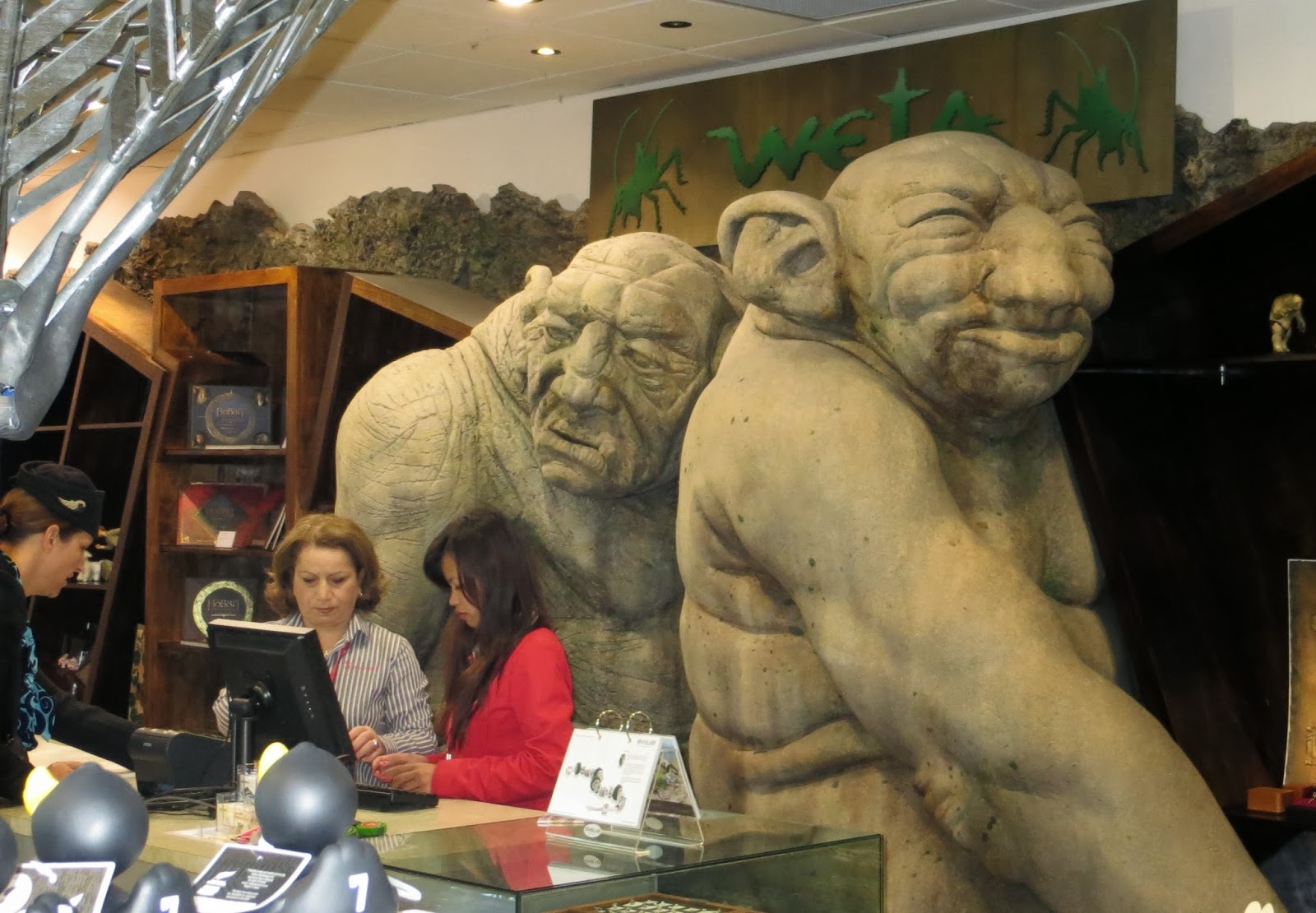
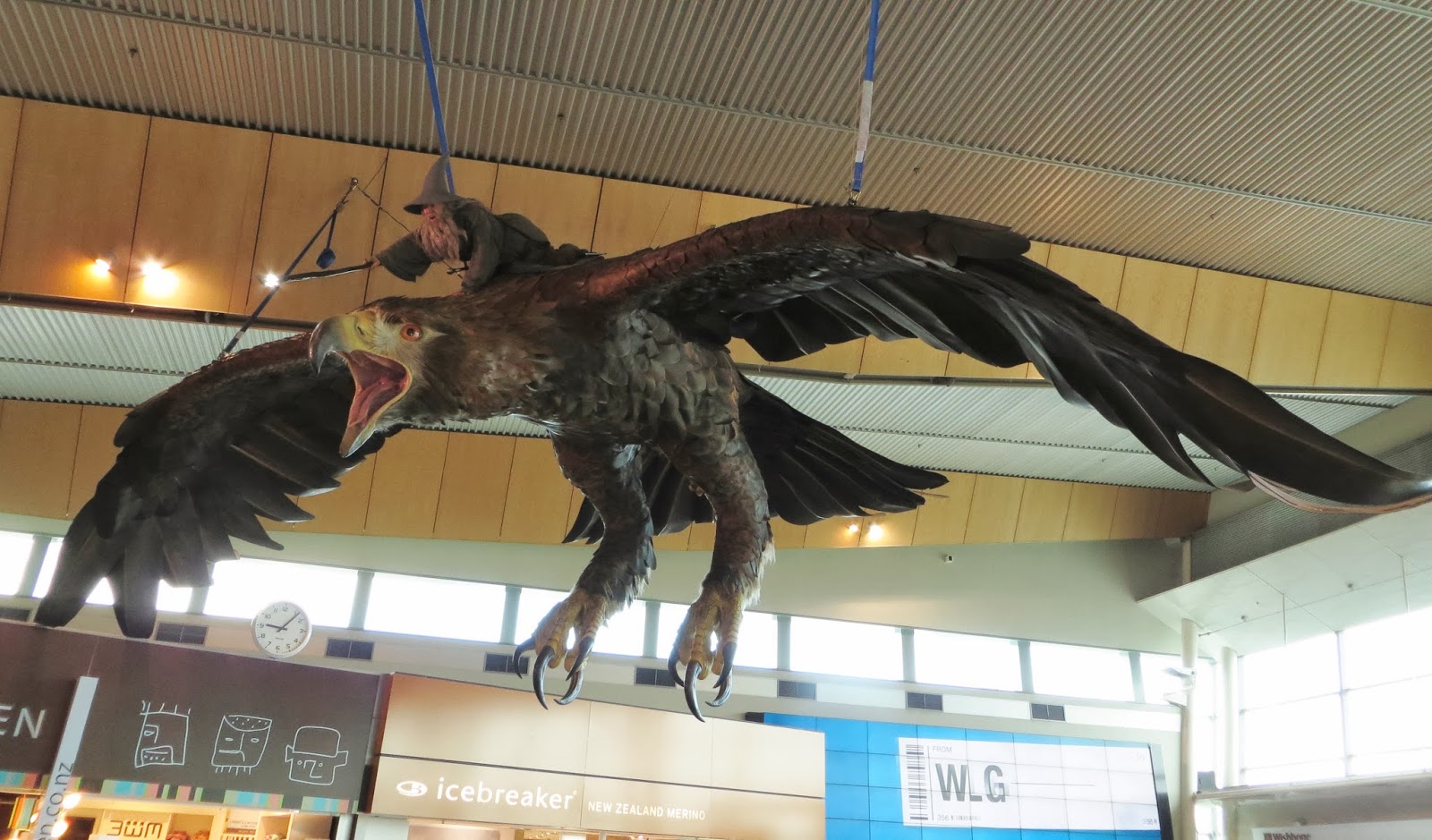
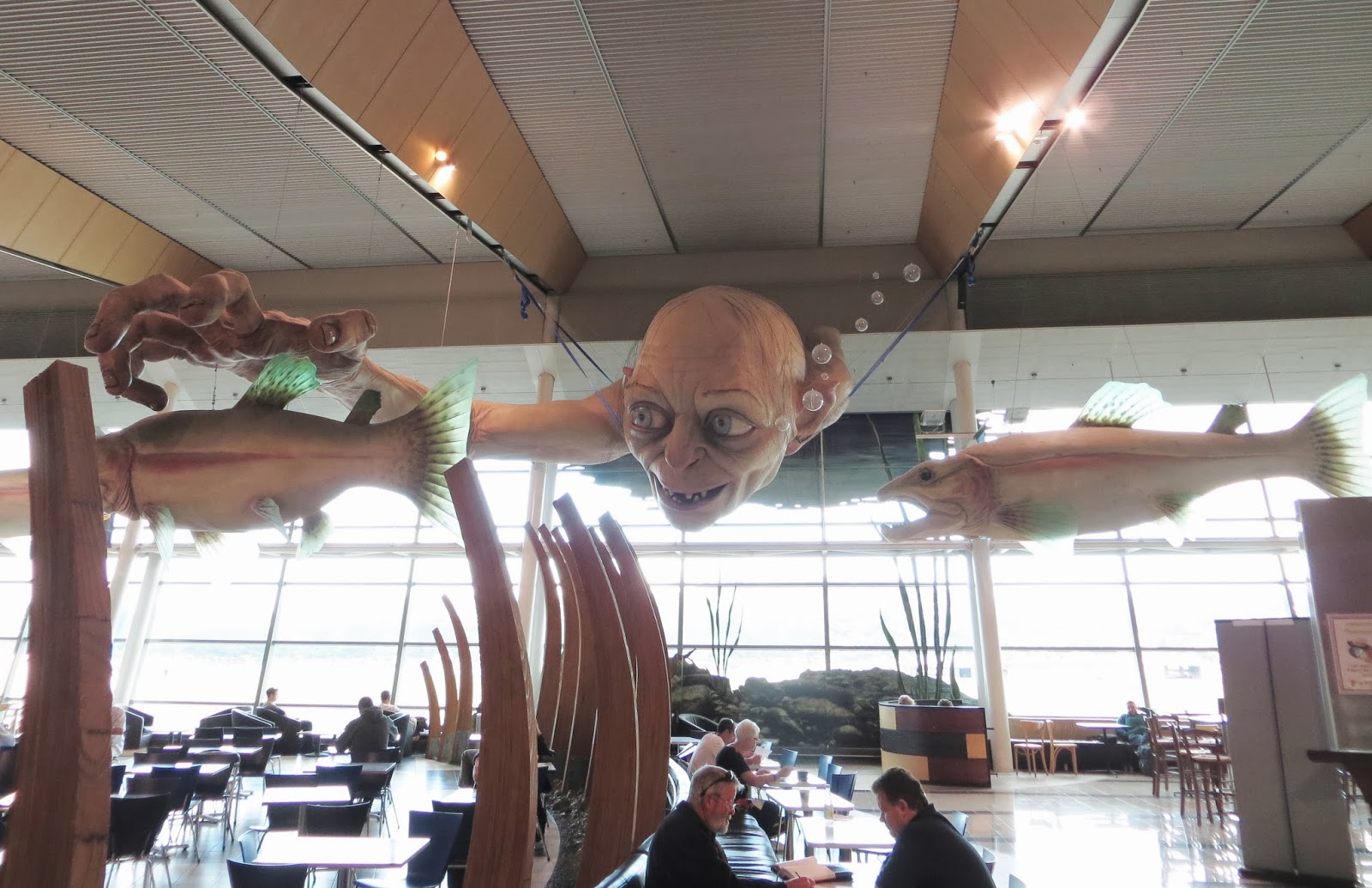
Friday, January 31, we took the short flight to Timaru aboard a wee plane. "Welliewood" is the center of the NZ film industry, and you can't avoid LOTR/Hobbit-related residua at the airport. [Worried that we might be deported, we did take in Hobbit Part II in Auckland. I was able to stay awake. No hobbits were harmed (that I remember.).]
The gift Shop
Not our plane (but about the same size)
Fresh fish
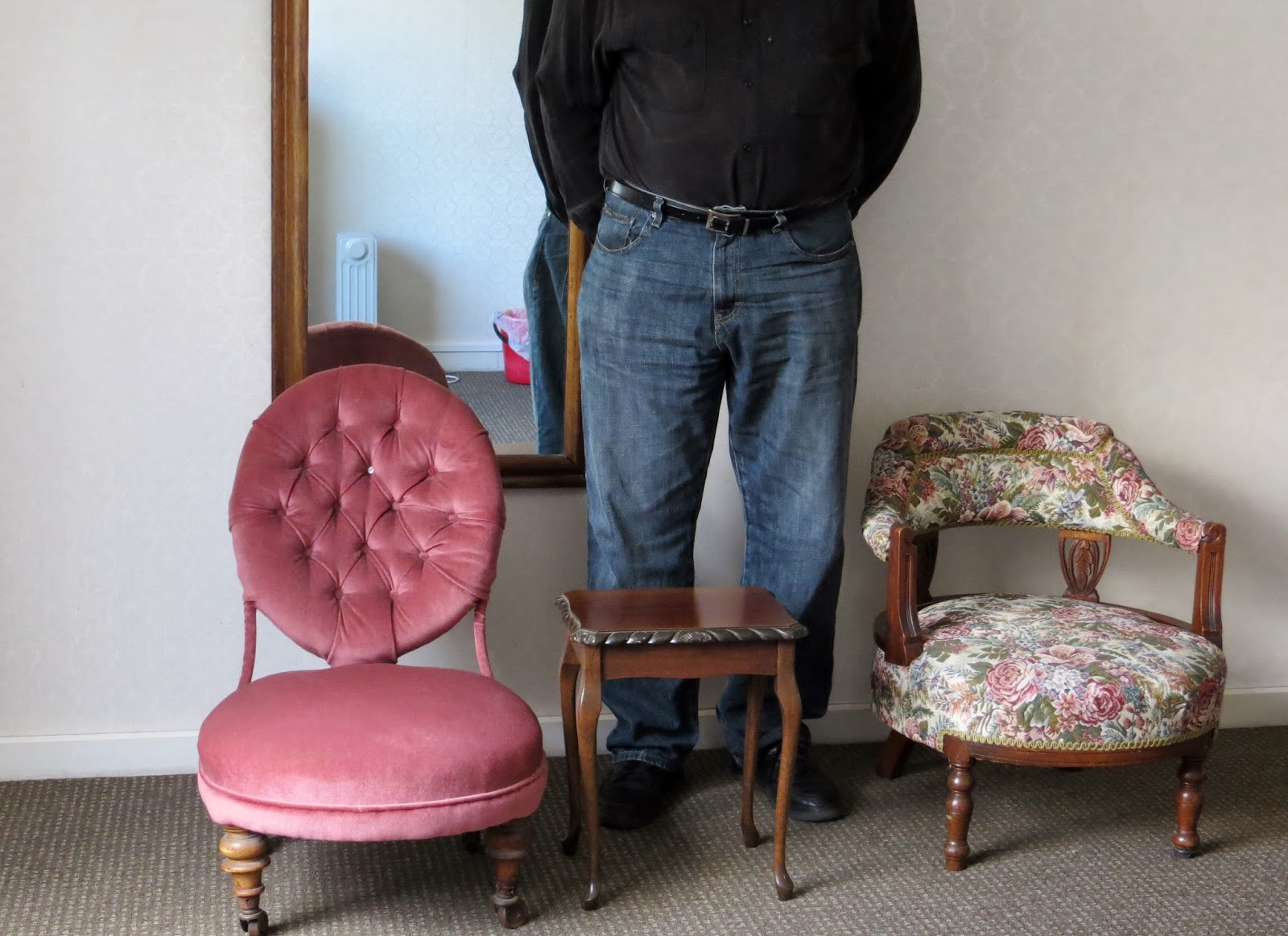
We were met at the Timaru Airport from Ross from HR, and driven to our temporary home. The Tolkien theme continued there, with Hobbit-sized furnishings.
Our bedroom furniture (for real!)
My contract started February 4, a Tuesday. I'm really not sure why that was the start date, but it allowed me to not work Monday the 3rd, which is the same day as the 2nd in the US, or as it was better known, Superbowl Sunday, 2014. My interest would have been even higher had a certain red and gold Bay Area team been playing, but as a red-blooded American, by noon I was ready for some gridiron....I mean, American football. I was quite worried about finding a place to watch it, as the interest here is minimal, but it was not only shown in several pubs, but on an obscure free TV channel usually airing Ceylon-Bangladesh cricket and Carlton vs.Adelaide Crows Aussie Rules footy. My liver and I survived the first half at the pub (feeling a bit like the Colts) [Correction: I still think of Peyton as a Colt, but of course I meant Broncos], and came home to watched the 2nd half on the newly installed telly. I liked Bruno Mars.
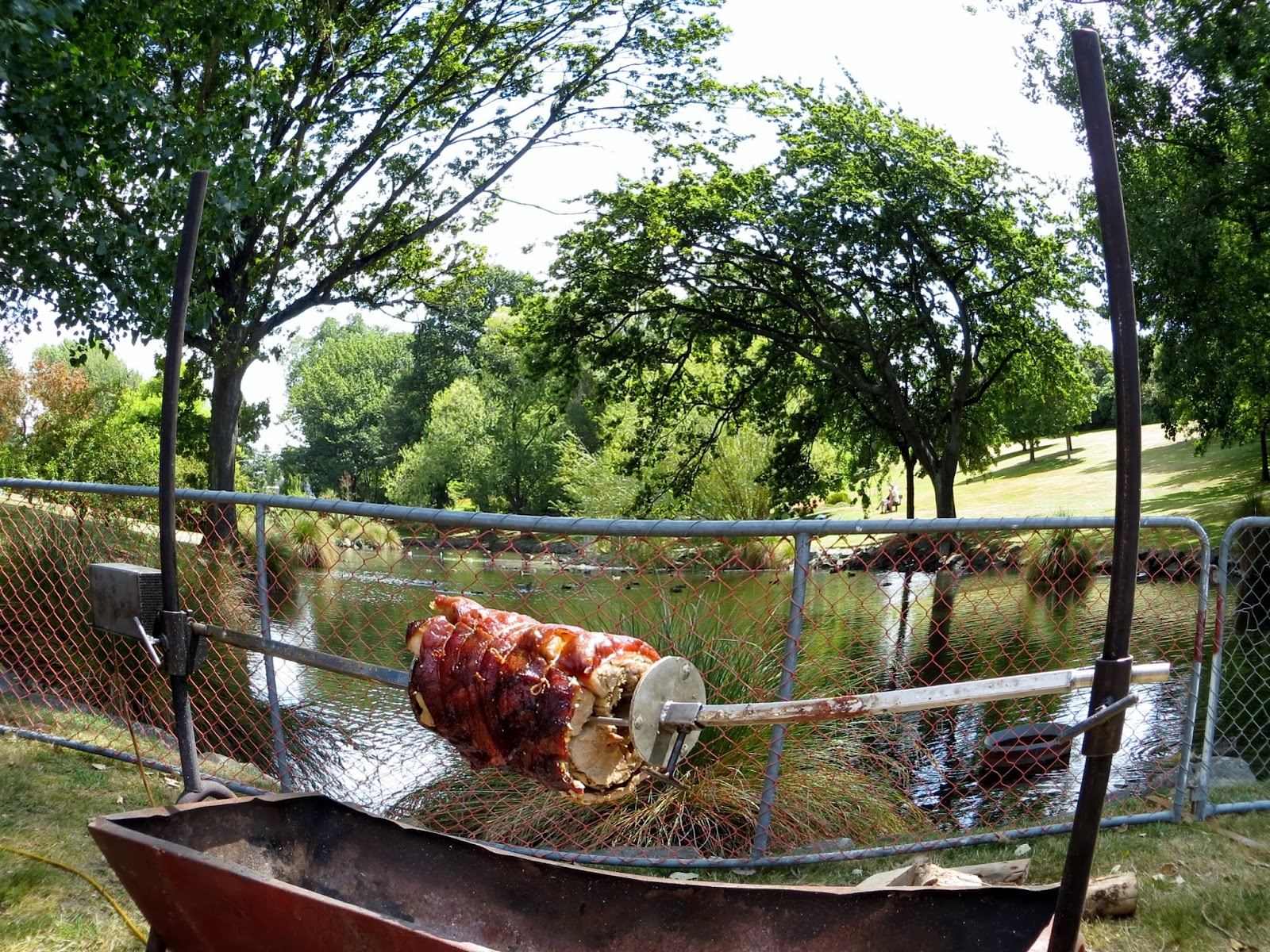
The rest of the first week was "orientation", easing back in, getting all the IT updates and passwords straight, and reacquainting ourselves with the town. The Botanic Garden hosted the yearly South Canterbury Food & Wine Festival, a benefit for Hospice (a low-key Winesong!, like in Fort Bragg).
Roasting pork at the SCF&W Festival
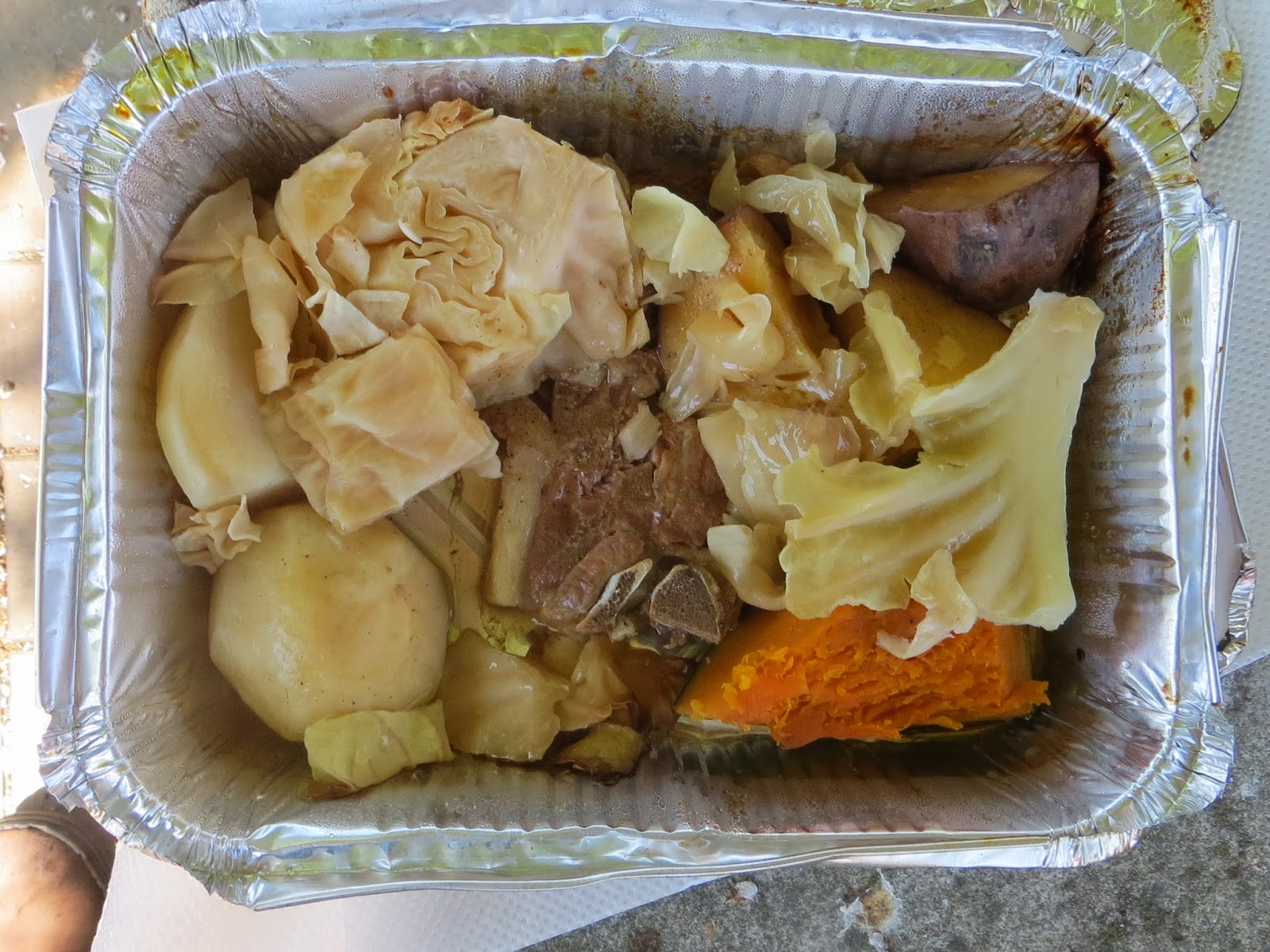
Thursday the 6th is Waitangi Day, a National holiday (more on that next post). We celebrated with a traditional Maori hangi, the NZ version of a Hawaiian luau.
Hangi Pit
The roast meat and veggies
Another thing we don't see much at home: hedgehogs, out and about in our neighborhood.
Next Post: Waitaingi Day, and back to work.

Sunday, February 9, 2014

Crossing a Few Things Off

We left SFO Wednesday January 22 and awoke two days later on Friday the 24th in Auckland, New Zealand. The title of the blog refers to the fact NZ is past the International Date Line, therefore one day ahead of the US, but most people notice a distinctly retro vibe, from the ambient music popular in the 70's and 80's, to an apparent simpler, more relaxed way of life we believe we led decades ago.
We have been in and out of Auckland several times, and lived here for over five months in 2012. I made many friends through my work at Auckland City Hospital, and my first stop was to visit the old crew. I was pleased to see the medical department had put the toaster oven I gifted them upon leaving to good use, and therefore associated me with warm, tasty snacks. Everyone was more than friendly, I attended Journal Club at noon, and had a free meal at their expense. 
The next day, my former chief Robyn and her partner John invited Fayne and me out to her renovated "bach" (pronounced like batch) on Waiheke Island, part of Auckland but worlds apart. A bach is a common Kiwi term best explained as a beach house or vacation bungalow. Robyn's family has had one on Waiheke (part Mendocino, part Catalina), which they have extensively remodeled since our last visit. The view off the deck of the Huaraki Gulf is impressive.....
and they have put a lot of work into the garden terraces out the back.
We were treated to a delicious and healthy lunch with home-baked bread, followed by a brief walk along the shore. It was a perfect welcome-back to New Zealand. (Our 4-yo granddaughter Kimarra has been told we are away to "an island", and asks us via computer "are you still on the island?")
Mts. Tongariro (L) and Nhauruhoe (R)
After two nights in Auckland, we rented a car and headed south down the North Island, a five-hour drive to Tongariro National Park.In two prior stays in NZ encompassing 16 months, we managed to do a once-over most of the country's "must-do's". One major exception was the Tongariro Alpine Crossing, a very popular 19.4 km (11.6 mi) traverse between two iconic active volcanoes, Mounts Tongoriro and Ngauruhoe (aka Mount Doom of the LOTR series). These two, along with Mt. Ruapehu (the most active, highest of the three, and home to NZ's largest ski resort) constitute the heart of the Kiwi's oldest national park, and the fourth oldest in the world. In 1887, Horonuku Te Heuheu Tukino IV, chief of the Ngati Tuwharetoa Maori, gifted this sacred land to the state. It is rich in native mythical and spiritual significance, and is one of the few places that is both a UNESCO World Heritage Site for both natural and cultural significance. We stayed at the Chateau Tongariro in the shawdow of Ruapehu.
When I tried in 2011 to do the crossing it was not possible due to poor weather. Since, I have learned it is a common occurrence for planned hikes to be sabotaged by inclement weather. I gave myself a three-day window to accomplish my goal this time. On Day One it poured (more rain than I had seen the last 18 months in California). Day Two I gave the weather time to settle, and it was calm and clear enough to take the chair-lift up Mount Ruapehu to "New Zealand's highest cafe" (and at 2020m, or 6400', I suspect the highest in all of Australasia), and to enjoy commanding views of the park and volcanic-sculpted features, like Meads Wall. 
Meads Wall
Day three was "the clearest day in a month", so I took the shuttle to the trail-head. The trek took me 8 hours, a fairly average time, without taking any side-trips, such as the estimated 3 extra hours to scramble up the to the top of Ngauruhoe, made more dangerous due to intermittent gale-force winds (ie: the reason it was "the clearest day in a month").
Mt. Ngauruhoe
The Crossing is full of iconic, volcanic vistas, and my photos hardly do it justice.
Red Crater in foreground of Mt.Ng...
A wayward pilgrim near the high point of the trail with Emerald Lake behind
Looking back from Blue Lake, across Central Crater to Red Crater, Mt. Ngauruhoe, and Mt. Ruapehu in the distance.
The last part of the trail descended down the north side of Tongariro, the site of the most recent eruption in August, 2012. One day prior to that event, we were on White Island, a volcanic island in the same chain, and missed the eruption by one day (if interested, look down near ths bottom of this long, prior blog posting).
Vent of the most recent eruption
It was a long and strenuous day, perhaps made more so by three factors: the altitude (nearly 6,000' at its highest), the gusty winds, and unstable footing in places. My advice for anyone in fair fitness planning on the Crossing: 1) Allow yourself a several-day window for passable conditions, 2) Only try it in good weather, and 3) Bring one or two walking sticks. Unless you are a glutton for punishment, don't do it in wet, foggy, or icy weather. You won't be able to see much, and it will be much more treacherous. Bottom line: it was worth doing, and I would consider doing it again sometime.
I treated myself to a grand dinner at the Chateau Tongariro, and the next day we headed off to Wellington. The drive is beautiful, and reminded me of the kooky road-side landmarks that are part of Kiwiana.
Giant Kiwi sculptures in Otorohanga
A gigantic gumboot in Taihape, looking for a mate

Wednesday, February 5, 2014

Leaving Again for New Zealand


Celebrating my 63rd birthday with family
For the third time since 2010, Fayne and I are headed back to New Zealand. The first time, April 2010-March 2011, was essentially on a whim. We had no idea what to expect, at work or at play. We loved both. The second time, March 2012-August 2012, we came back this time to Auckland, specifically so I could qualify for a permanent medical license, or registration as it is called here. I wanted the flexibility to come and go to work more freely, and split time between US and NZ work.
 For the last 18 months, we have been back in Fort Bragg, California, and I worked full-time at Mendocino Coast District Hospital as a hospital doctor. Like many small rural American hospitals, the place I have worked since 1984 was in great financial peril, and filing for Chapter 9 bankruptcy. Over the last year and 1/2, many key people have left or been fired, the workers have been coerced into a 5% cut, and yet if anything things are more tenuous. The Hospital Board Chairman called the November 2013 finances "dire", and another board member told me he learned that bankruptcy doesn't solve anything, it only delays the inevitable.The best hope seems to be that some outside institution will sweep in like a deus ex machina, and take over.
Work is so much more fun in New Zealand. Hours are shorter, vacations, holidays, and educational leave are all paid for, as well as registration fees. More importantly, I get to work daily with young, bright, enthusiastic doctors who feel I have something to teach them. In the US, find myself spending at least half of my day with drudgery, paperwork, computer entry. I have virtually none of that in New Zealand.
These factors have led me to a momentous decision: for the foreseeable future, I will be working in New Zealand. It is difficult to think about being so far away from so many of our beloved family and friends, especially our daughter and grandchildren. We also will dearly miss our beautiful Fort Bragg home, and our aging cat Saturday.
But I still really enjoy being a physician, and hope to work for another 5-10 years, if circumstances allow it.
When I decided to return to NZ, I first contacted Timaru and Auckland City Hospitals, the two places I worked before, and I was very gratified to see that they both would welcome me back. Timaru offered a contract which specifically states that I can return to the US at least twice a year to see family. Also, 3 of the 4 other doctors I will join were colleagues of mine from the first stay. So it was a done deal. We will give it a try and see how it goes, knowing the future can be impossible to foresee.
I learned that deeply and personally when my elder sister Angela died abruptly after a sudden catastrophic illness in early November. We had a lovely memorial/tree-trimming part for her one month later. May she rest in peace, and we know the two kidneys she donated live on to give life to others.
Sisters Athena and Margaret addressing the large memorial crowd
I am so glad she made it to see me in New Zealand in 2010.
We tried to see as many as we could in the months before departing. For the first time ever we spent Christmas time with Fayne's sister and brother in Albany and Syracuse , New York, respectively.
Laura Fayne Hedden and Ryan Brennan
The Brennans
We of course made time to sample the local fare, including the semi-famous "Funk 'n Waffles" in a basement near the Syracuse U. campus (featured on Guy Fieri's "Diners, Drive-Ins, and Dives", thanks to a tip from Sofia)..
The Jive Turkey: Waffle made of stuffing with all the trimmings
All Shook Up: An homage to The King with bacon, bananas, PB, & honey
I had to make time for a Holiday meal with the heart of my long-time office staff, Judy and Linnea (Terry couldn't make it),
and with my surrogate family, the Nestlers.
The Holiday season is even more special than ever as we celebrated Kimarra's 4th birthday,
 
Isaiah's 1st birthday with Sofia and Marquise.


[NOTE: Many of my prior blog-followers urged me to resume a blog in order to keep in closer contact across the thousands of miles. I am not quite sure what shape it will take, but will update it when I feel I have things to share. I am open for suggestions.]